They say a mother’s intuition is the strongest force on earth, but after forty-seven days of silence, even intuition begins to wither under the weight of despair. When my fourteen-year-old son, Caleb, vanished into thin air on a crisp Monday morning in September, the world as I knew it ceased to exist. He had only four hundred yards to walk from our front door to the school bus stop—a distance I had watched him traverse hundreds of times. But that morning, he never stepped onto the bus. His phone pinged one last time at 8:12 AM and then went dark. For the authorities, he became a case file. For the community, he became a tragic cautionary tale. But for me, he was a hole in my heart that refused to heal.
The first week of the disappearance was a whirlwind of blue lights, sirens, and forensic teams. The police searched with an intensity that gave me a flicker of hope. However, by day nine, the atmosphere shifted. The language changed from “when we find him” to “if we find him.” By day twelve, the official search was scaled back to a “maintenance level.” I was told that without new evidence or a ransom demand, there was simply nowhere left to look. I was left sitting in my car at the local gas station, staring at the faded flyers taped to my windows, feeling the crushing weight of being the only person left on earth who still believed Caleb was alive.
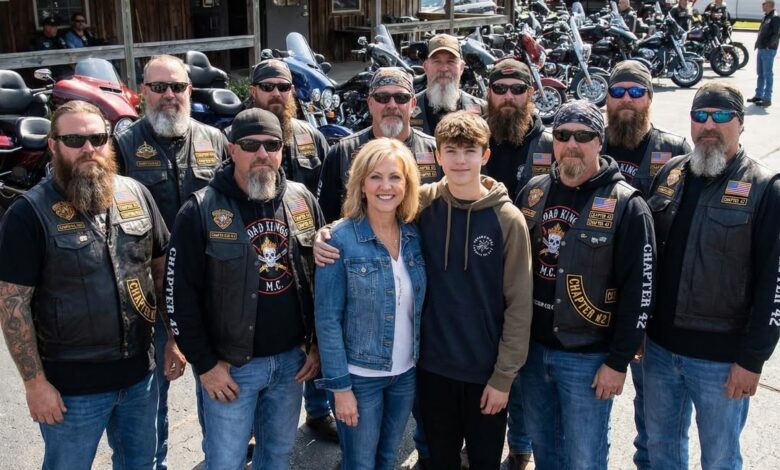
That was the day I met Walt. He didn’t look like a savior; he looked like the kind of man people usually avoid in dark alleys. Clad in oil-stained leather and sporting a beard that had seen better decades, he pulled his vintage motorcycle up to the pump and saw me. He didn’t offer platitudes or hollow promises of prayer. He looked at the flyers, looked at my tear-streaked face, and asked a single, piercing question: “How many people are still looking?” When I whispered that it was just me, he didn’t hesitate. He made one phone call, and by that evening, my kitchen was filled with the scent of leather, tobacco, and purpose. Thirty-one bikers sat around my table, spreading out topographical maps like generals preparing for a siege.
Walt’s philosophy was simple: “We don’t quit. That’s not a slogan; it’s how we operate.” While the official investigation hit a wall, these men went where the police wouldn’t. They rode through back-alley truck stops, hiked into homeless encampments, and explored every abandoned structure across the county line. They divided the map into a meticulous grid, and for forty-seven straight days, they woke up at 4 AM to scour the earth for a boy they had never met. They weren’t paid, they weren’t seeking glory, and they certainly weren’t following a protocol. They were following a code of honor that dictated no one gets left behind.
As the weeks dragged on, the physical and emotional toll was staggering. By day 44, the white squares on Walt’s map—the areas yet to be searched—were nearly gone. My hope had eroded into a numb, hollow ache. I called Walt on the night of day 46, my voice breaking as I told him that maybe the police were right—maybe Caleb was gone. The silence on the other end of the line lasted a long time before Walt spoke with a gravelly determination. “There are four grids left. Give me two more days.”
At 6 AM on day 47, my phone rang. It wasn’t the steady, stoic Walt I had come to know; his voice was shaking with an emotion he couldn’t hide. He told me to drive to Miller Creek Road and to “bring a blanket.” Those three words are the most terrifying and hopeful words a parent can hear. I drove like a woman possessed, the blue blanket from Caleb’s bed sitting in the passenger seat like a silent passenger. When I arrived at the remote ravine, eleven miles outside of town, I saw the motorcycles parked like sentinels along the dirt shoulder.
Down in a hidden ravine, buried under decades of vines and rot, stood a collapsed hunting cabin that was invisible from the road and the air. There, at the bottom of a steep embankment, Walt and his crew had found him. Caleb had tripped on the first day, shattering his ankle and rendering him unable to walk. He had crawled through the brush for hours until he found the shelter of the shack. For nearly seven weeks, my son had survived on rainwater from a nearby creek and whatever meager vegetation he could identify from survival shows he’d seen on television. He had lost thirty pounds. He was paper-thin and shivering, his body on the verge of total shutdown, but his eyes were open.
The reunion was a blur of tears and thermal blankets. When Caleb felt the familiar fabric of his own bedspread, he finally let go of the iron-clad survival instinct that had kept him alive. As we rode in the ambulance, his bony fingers gripped mine with a strength that defied his condition. Later, as he recovered in the hospital, the truth of his disappearance came to light. It wasn’t a kidnapping or a random act of violence; it was the result of a relentless, cruel bullying campaign at school that had pushed a fourteen-year-old boy to the brink. He hadn’t run away to start a new life; he had run into the woods because he felt the world had no place for him.
The bikers stayed by our side throughout the recovery. They didn’t just find him in the woods; they helped find him in the aftermath. Walt visited every Sunday, sitting on our porch with donuts, providing a silent, steady presence that helped Caleb navigate the trauma of his ordeal. They taught him that while some people are cruel, there are others—strangers in leather vests—who will move mountains to bring you home.
A year later, the scars are still there, but they are healing. Caleb is fifteen now, walking with a slight limp but a much stronger spirit. He recently asked Walt to teach him how to ride when he turns sixteen. Looking back on those forty-seven days, I realize that the miracle wasn’t just that Caleb survived the elements. The miracle was that thirty-one men refused to accept the “inevitable.” They ignored the statistics, the police reports, and the passage of time. They proved that hope isn’t something you wait for; it’s something you manufacture with grit, gasoline, and a refusal to turn back. They saved my son’s life, but more than that, they restored my faith in the hidden goodness of the world. In the end, it wasn’t the system that brought my boy home; it was a miracle wrapped in leather and chrome.